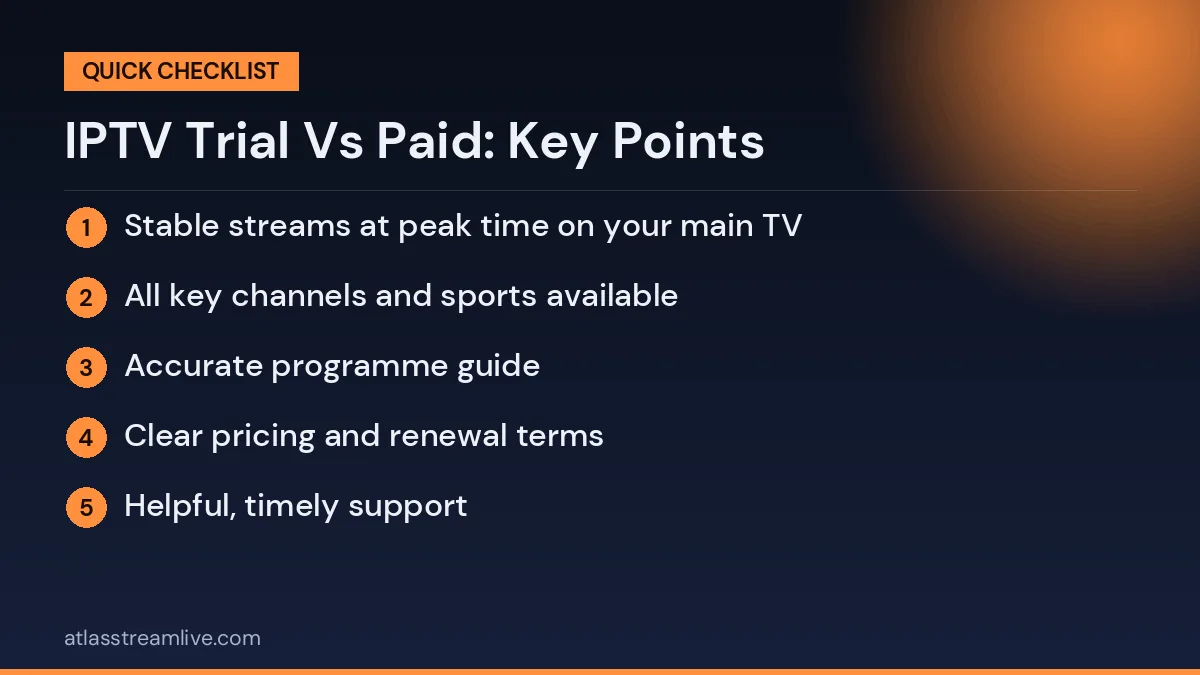
Comparing an IPTV trial vs paid subscription is the best way to know whether a service will live up to its promises once you start paying.
One assumption a lot of UK subscribers make is that whatever they experience during an IPTV trial is exactly what they’ll get after paying. This is true with reputable providers, but it’s not universally guaranteed across the entire market, and understanding the difference helps you make a more informed decision before committing to a subscription.
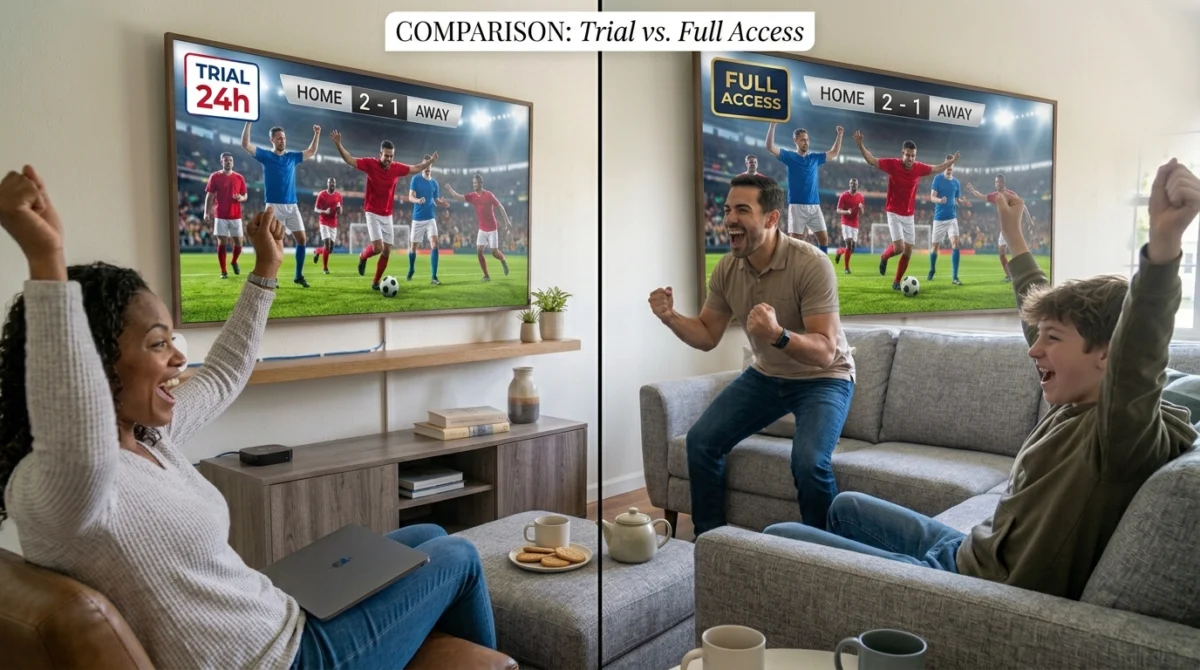
With a genuinely transparent provider, the trial period gives you full access to the same channels, the same stream quality, and the same server infrastructure you’d use as a paying subscriber. There’s no legitimate reason for a provider to deliberately perform better during a trial than after payment, since the whole point of offering a trial is to demonstrate accurately what you’re paying for.
Server capacity, channel reliability, and support responsiveness should all remain consistent whether you’re a trial user or a long term subscriber. If a provider’s infrastructure can’t handle peak demand during a trial, it won’t suddenly improve once you’ve paid.

Want to test it on your own TV first? Try AtlasStream Live free for 24 hours on your Firestick, Smart TV or phone. No payment needed.
UK viewing patterns around football create predictable peak demand periods, weekend fixtures, midweek European fixtures, and major tournaments. If your trial happens to fall during a quieter period and doesn’t represent how the service performs during these UK specific peak times, you might end up with an inaccurate impression either way. This is why testing during an actual live match matters more than testing during a random quiet period, regardless of how transparent the provider is.
IPTV Trial vs Paid: A Side-by-Side Comparison
The question of IPTV trial vs paid service comes down to one thing: whether what you test is what you will actually get. This table shows what should normally stay the same and what can reasonably differ.
| Feature | During the trial | After you pay |
|---|---|---|
| Picture quality | Same servers and quality | Should be identical |
| Channel line-up | Usually the full list | Should match what you tested |
| Programme guide | Included | Included |
| Connections | Often one screen | As many as your plan includes |
| Duration | Usually 24 hours | The length of your plan |
| Support | Available | Available, ideally with priority |
If anything other than the number of connections and the duration changes after you pay, ask the provider why.
How to Plan a 24-Hour Trial
A short trial goes quickly. Planning it means you finish with a clear answer about the IPTV trial vs paid experience rather than a vague impression.
- Start in the afternoon so your trial covers one full evening, which is the most demanding time.
- Install on your main device first, the one you will use every day.
- Watch live during peak hours, ideally a sports event, for at least 30 minutes.
- Test the guide for tonight and tomorrow.
- Try on demand by starting a film and skipping forward.
- Contact support with a simple question and note the reply time.
- Check a second device the next morning.
Why Some Trials Feel Better Than the Paid Service
Most people who are disappointed after paying were not misled on purpose. More often, they tested at the wrong time. A trial taken on a quiet weekday morning can feel perfect, while the same service on a Saturday evening during a big match faces far more demand. When that person pays and starts watching at peak times, it feels like the service got worse, even though nothing changed.
The solution is simple: test at the times you will actually watch. If you mainly watch sport at weekends, make sure your trial covers a weekend evening. If you watch the news every night at ten, test at ten.
What to Write Down During Your Trial
Keep a short record as you go. It makes the decision easier and gives you something to compare against once you have paid.
- The time you started each test.
- Which channels you watched and whether they buffered.
- How long the programme guide took to load.
- Whether on-demand titles started quickly.
- How long support took to reply, and whether the answer helped.
If the paid service later seems different, these notes give you specific examples to share with support.
Upgrading From a Trial Without Starting Again
With many services, including AtlasStream Live, using the same email address when you buy means the line you tested is upgraded. You keep the same username and password, your favourites stay in place, and there is nothing to set up a second time. This is the smoothest way to move from trial to paid. If you use a different email, you may need to set everything up again from scratch.
Choosing a First Plan After Your Trial
Even after a great trial, start with a short plan. A single day cannot show you how a service behaves over weeks: during different sports, busy holidays and occasional maintenance. A one-month plan gives you that longer view at low risk. Once you have been happy for a month, a longer plan lowers the cost per month.
| Your trial result | Sensible next step |
|---|---|
| Excellent at peak times, support quick | One month, then consider a longer plan |
| Good, with minor issues | One month, and test the issues again |
| Frequent buffering at peak times | Check your own Wi-Fi first, then try another service |
| No reply from support | Do not pay yet |
Is the Problem the Service or Your Home Network?
If you see buffering during a trial, test another app on the same device, such as BBC iPlayer or YouTube. If those also struggle, the problem is your connection rather than the service. A wired Ethernet connection or a better Wi-Fi signal near the TV often fixes this. Ofcom has helpful guidance on improving home broadband on its website.
Questions to Ask Before Moving From Trial to Paid
- Will my paid account use the same servers I tested?
- How many connections does each plan include?
- Is the renewal price the same as the first payment?
- Does the plan renew automatically?
- What is the refund policy if the service changes?
- Can I keep my trial login details and favourites?
A provider that answers these clearly is giving you the confidence to commit. A provider that dodges them is giving you a reason to wait.
IPTV Trial vs Paid: Red Flags
- A trial that needs your card and starts billing automatically if you forget to cancel.
- A trial limited to a few channels that does not show what the full service is really like.
- Different apps for the trial and the paid version.
- Support that disappears once you have paid.
- Pressure to buy a long plan before the trial has ended.
Making Your Trial Count for the Whole Household
If several people will use the service, involve them in the trial. Let the sport fan test a live match, the film lover try the on-demand section, and the children check their favourite channels with the parental PIN switched on. Each person notices different things. One trial tested by the whole household gives you a far better picture than one person flicking through channels alone.
Remember that most trials allow only one screen at a time, so take turns rather than testing on several devices at once. Your paid plan can include more connections later.
After You Pay: The First Week
Treat the first week of a paid plan as an extension of your trial. Watch at your usual times, keep an eye on stability during busy evenings, and note anything that feels different. If something changes compared with the trial, contact support straight away. The sooner you raise an issue, the easier it is to resolve, and the more options you have under the refund policy.
Testing the Details Most People Miss
Beyond picture quality, a few smaller details make a big difference in daily use, and they are easy to forget during a trial.
Subtitles and audio tracks
If anyone at home relies on subtitles, check they appear on the channels and films you watch. Try switching audio tracks on a film that offers more than one language.
Catch up
If you often miss programmes, test catch up on a channel you watch regularly. See how far back it goes and how easy it is to find yesterday evening programmes.
Start-up time
Notice how long the app takes to open and load your channel list from a cold start. A few seconds is normal; a long wait every evening becomes annoying quickly.
Search
Search for a channel or film by name. A good search function saves a lot of scrolling once you have thousands of options.
These are small things on their own, but together they decide whether a service feels easy and pleasant to use every day, which is ultimately what you are paying for.
Keeping Expectations Realistic
No service is flawless on every connection at every moment. Occasional short buffering during the most watched events of the year can happen anywhere, including on traditional TV services. What matters is how often it happens, how quickly it recovers and how helpful support is when you need it. Judge the trial on those realistic standards and you will make a fair, confident decision.
Plan the trial, test honestly, start with a short plan and keep notes. That simple routine is all it takes to move from a free trial to a paid service you are genuinely happy with.