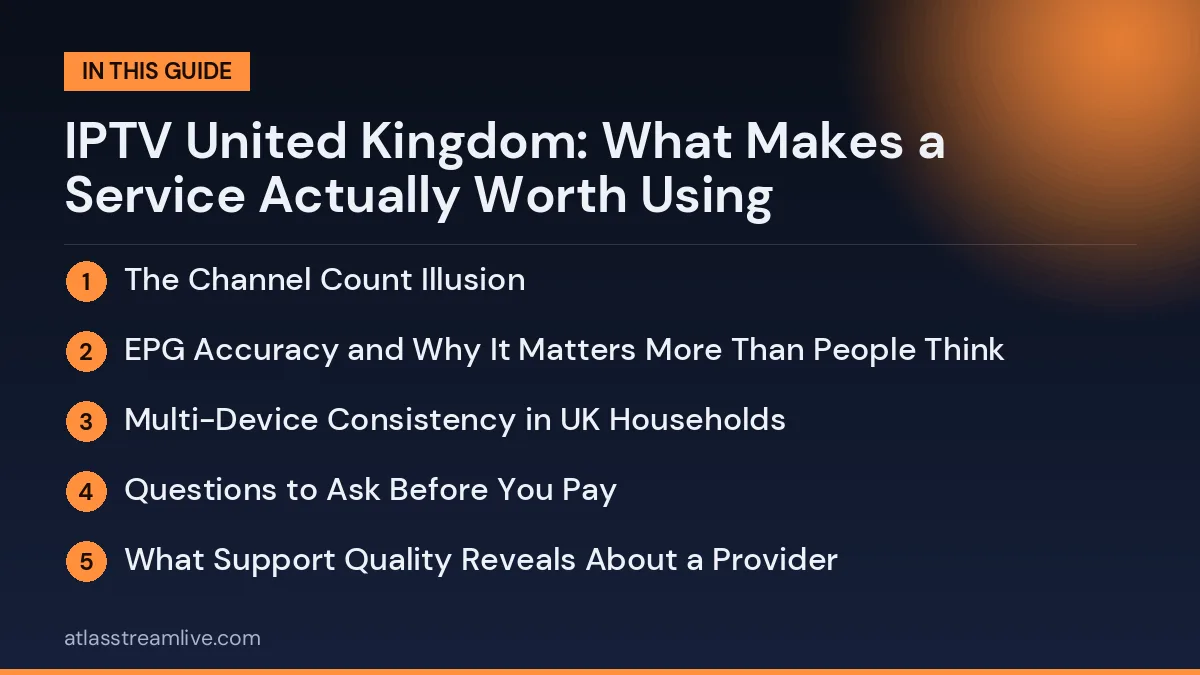
IPTV United Kingdom: What Makes a Service Actually Worth Using
Choosing IPTV United Kingdom services can be confusing. The UK IPTV market is full of similar-looking services that perform very differently in practice. Here is what to actually look for.
Last updated: 16 October 2026
The IPTV market in the United Kingdom has grown considerably over the past few years, and with that growth has come a predictable flood of providers all making nearly identical promises. Tens of thousands of channels, crystal-clear quality, instant setup, no contract. Walk through enough of these provider websites and you start to wonder whether anyone has actually tested any of these claims under real conditions or whether the entire market is running on the same copy-and-paste marketing template.
The honest answer is that the services themselves vary enormously despite their similar-looking marketing pages. Some genuinely deliver a reliable, complete live television experience that holds up during the moments that matter most for UK viewers. Others scrape by during quiet periods and fall apart precisely when you need them to work. Understanding what actually separates the two categories changes how you evaluate any provider and saves you from the frustrating cycle of subscribing, discovering problems, cancelling, and starting again.
Want to test it on your own TV first? Try AtlasStream Live free for 24 hours on your Firestick, Smart TV or phone. No payment needed.
Why Live Sport Is the Real Test for IPTV United Kingdom Services
The United Kingdom has one of the most competitive sports broadcasting markets in the world. Premier League football generates enormous simultaneous viewership every weekend during the season, Champions League midweek fixtures add to that load, and major events like international tournaments or heavyweight boxing push simultaneous demand even higher. This concentrated, predictable peak demand is what separates a well-resourced IPTV service from one that is running its infrastructure closer to the edge than its marketing would suggest.
A service that streams smoothly during a quiet Wednesday afternoon tells you almost nothing about how it will perform at a weekend kick-off when tens of thousands of subscribers are all opening the same live match simultaneously. That moment of peak concurrent demand is the genuine test of server infrastructure quality, and it is the one test that no provider’s marketing page can fake. Only a trial conducted during an actual live match gives you the information you need.
The Channel Count Illusion
Every IPTV service in the United Kingdom advertises a large channel count, and the numbers have grown increasingly inflated as providers compete to outlist each other. Fifty thousand channels. Eighty thousand channels. The figures become almost meaningless when you understand that a meaningful proportion of those listed channels are either duplicates, inactive streams, or channels from regions with no relevance to your viewing habits.
What matters for a UK subscriber is not the total channel count but whether the specific channels they actually watch are reliably available and consistently maintained. Sky Sports Main Event, Sky Sports Premier League, TNT Sports, BBC One, ITV, Channel 4, and whatever other channels form your regular viewing habits, these are the channels worth testing specifically rather than being impressed by a headline number that includes five hundred regional channels from countries you have never visited.
EPG Accuracy and Why It Matters More Than People Think
The Electronic Programme Guide, the on-screen television guide that shows what is currently airing and what is coming up, is one of those features that gets overlooked in provider comparisons until you are actually using a service daily and realise how much you rely on it. A good EPG lets you check what is on without opening each channel individually, plan what you want to watch later, and navigate a large channel list without it feeling like a guessing game.
EPG quality varies considerably across the UK IPTV market. Some providers maintain accurate, up-to-date guide data that reflects actual broadcast schedules including schedule changes and live event overruns. Others display guide data that is hours behind the actual broadcast, shows incorrect programme information, or simply shows nothing at all for large portions of the channel list. For casual browsing this is an inconvenience. For anyone who watches television the way most people actually do, checking what is on before deciding what to put on, it is a meaningful daily frustration.
Multi-Device Consistency in UK Households
The average UK household now watches television across multiple screens. The main television in the living room, a secondary screen in another room, and mobile devices for watching on the move have become the standard rather than the exception. An IPTV service that performs excellently on one device type but struggles on another is only partially solving the problem for households with varied viewing setups.
Testing a service across every device you actually intend to use, rather than only the most convenient device for initial setup, reveals compatibility and performance variations that are otherwise invisible until you have already committed to a subscription. A Firestick might deliver perfect streams while the same service struggles on a Samsung Smart TV, or vice versa. These differences exist across the market and the only way to know whether they affect your specific setup is to test directly.
Questions to Ask Before You Pay
Before choosing an IPTV United Kingdom service, ask a few direct questions. How many devices can stream at the same time? Which UK channels and sports are included? Is there a free trial, and what happens when it ends? How quickly does support reply, and through which channels? Are there any extra fees for connections, categories or renewals? A reliable provider answers clearly and in writing. Vague replies, pressure to pay immediately or refusals to explain the basics are warning signs. Keep the answers in an email or chat so you can refer back to them later if anything changes.
What Support Quality Reveals About a Provider
The support experience a provider offers tells you more about how they operate than almost any other single factor. A provider that responds within minutes through WhatsApp when something goes wrong during a live broadcast is demonstrating that they take the customer relationship seriously enough to invest in rapid response capability. A provider that routes all support through an email ticketing system with a twenty-four to forty-eight hour response window is effectively telling you that your problem, however time-sensitive, will wait until it is convenient for them.
For IPTV specifically, where the most common and frustrating issues tend to occur during live broadcasts at specific times, the response speed matters enormously. A stream that drops during a cup final is not a problem that benefits from being resolved the following afternoon. Testing support during a trial period by sending a genuine question gives you a direct preview of what you can expect once you are a paying subscriber with a real issue that needs resolving quickly.
Pricing That Reflects Real Infrastructure Costs
Running a quality IPTV service in the United Kingdom costs money. Server infrastructure capable of handling the peak concurrent demand that UK sports viewing creates, channel maintenance teams that keep streams active and current, and support staff who respond quickly are all genuine operational costs that responsible providers account for in their pricing.
Services priced significantly below the market average are almost always cutting costs somewhere in this chain, and the most common place that cost cutting manifests is server capacity, since this is the largest infrastructure expense and the one most invisible to subscribers until it fails under load. A few pounds per month saved on a subscription has a way of costing considerably more in frustration when a service falls apart at the worst possible moments.
What a Reliable IPTV United Kingdom Service Looks Like
A service worth using in the United Kingdom maintains stream quality during Premier League weekend fixtures and Champions League midweek evenings without buffering that traces back to server overload. It carries the specific channels UK subscribers actually watch with guide data that accurately reflects real broadcast schedules. It works consistently across Smart TVs, Firestick, Android boxes, and mobile devices rather than excelling on one platform while struggling on others. And it resolves issues quickly through real-time support rather than making subscribers wait while their problem sits in an email queue.
AtlasStream Live offers a free 24-hour trial with no card needed, so you can test it against exactly these standards, ideally during a live match. If you have a question while testing, you can message support on WhatsApp and judge the reply for yourself. Start a free trial with AtlasStream Live here and run the test using the criteria above. That test gives you the only evaluation that actually matters: real-world performance under the conditions you will actually be using it.
How to Evaluate Any UK IPTV Provider Before Subscribing
Apply the same checklist to any provider you are considering. Test during a live sports broadcast rather than during a quiet period. Check the specific channels you actually watch rather than being impressed by a headline number. Verify EPG accuracy on channels you know well enough to spot errors. Test on every device you plan to use. Send a support question and time the response. Start with a short-term plan before committing to an annual subscription.
This process takes a few days done properly, but it reliably separates providers who deliver what they advertise from those who look identical on paper but fall short in practice. The IPTV market in the United Kingdom is competitive enough that genuinely good services exist. The task is identifying them through direct evaluation rather than marketing comparison. Try AtlasStream Live free here and run that evaluation yourself before making any decisions.
The Bottom Line
What makes an IPTV service actually worth using in the United Kingdom comes down to a small number of practical factors that are all invisible from a marketing page and all verifiable from a properly conducted trial. Peak demand server stability, channel maintenance quality, EPG accuracy, cross-device consistency, and support responsiveness separate the services worth keeping from the ones worth cancelling. Test with these criteria in mind rather than being swayed by channel counts and pricing alone, and the decision becomes considerably more straightforward than the crowded market initially makes it appear.
IPTV United Kingdom and Home Broadband: What Your Connection Can Handle
Any IPTV United Kingdom service is only as good as the broadband it runs on. The good news is that most UK homes now have connections that comfortably support HD streaming. Ofcom publishes regular reports on home broadband coverage and speeds, and full-fibre availability has grown quickly across the country.
Your broadband type
Typical experience
Standard ADSL (under 10 Mbps)
SD is fine; HD may buffer at busy times
Superfast fibre (30 to 80 Mbps)
Comfortable HD on two or three screens
Full fibre (100 Mbps and above)
4K and several devices at once without trouble
Speed is not the whole story. Wi-Fi coverage inside the home matters just as much. A TV at the far end of the house from the router may struggle even on a fast line, so a wired Ethernet cable or a mesh Wi-Fi system often makes a bigger difference than upgrading your package.
IPTV United Kingdom Across England, Scotland, Wales and Northern Ireland
The United Kingdom is not one single TV market. Regional news, regional versions of national channels and local listings differ between England, Scotland, Wales and Northern Ireland. A good IPTV United Kingdom service should reflect that, rather than offering one generic set of listings for everyone.
Regional programme guides
Check that the programme guide shows the right regional schedule for where you live. If your evening news or local programmes appear at the wrong times, the provider has not set up its guide data properly for your region.
Time zones and live events
All of the UK shares one time zone, but listings still need to switch correctly when the clocks change in March and October. A guide that is an hour out for days after the change is a small but telling sign of how carefully a service is maintained.
A Quick IPTV United Kingdom Checklist
Stable live channels during the busiest evening hours
An accurate programme guide for your part of the UK
Apps that work on every device in your home
Support that replies quickly with real answers
Clear pricing that stays the same at renewal
A free trial with no card required
If a service meets all six, it is worth considering. If it fails on stability or support, keep looking, because those are the two things that matter most once the novelty wears off.
IPTV United Kingdom: Common Questions
Do I need a TV aerial or satellite dish?
No. IPTV runs over your broadband connection, so there is no need for an aerial, dish or engineer visit. You only need a compatible device and a stable internet connection.
Which devices are most popular for IPTV in the UK?
Amazon Fire TV sticks, Android TV boxes and Samsung or LG Smart TVs are the most common, followed by phones and tablets for watching around the home.
How much should I expect to pay?
Prices vary widely. Rather than chasing the lowest number, compare the monthly cost across different plan lengths and make sure the renewal price is clearly stated before you pay.
Is it worth testing more than one service?
Yes. Trying two services during the same week, ideally including a live sports evening, gives you a direct comparison on your own connection and devices, which is far more useful than any online ranking.
Switching to IPTV United Kingdom From Cable or Satellite
Many people who look at IPTV United Kingdom services are coming from a traditional cable or satellite package. The switch is usually simple, but a little planning avoids a gap in your viewing.
Check your contract end date first
Most cable and satellite packages run on a minimum term. Leaving early can mean exit fees, so find your end date in your account or on a recent bill before you cancel anything. Citizens Advice has clear guidance on ending TV and broadband contracts.
Run both side by side for a short time
If you can, start a trial while your old service is still active. That way you can compare picture quality, channel switching and the programme guide directly, on the same TV, without any risk of being left with nothing to watch.
Keep your broadband, upgrade your Wi-Fi
Remember that cancelling a TV package does not mean cancelling broadband, which IPTV needs. If your broadband came bundled with the TV service, check you will keep the internet connection before you cancel. This is also a good moment to improve Wi-Fi coverage near the TV.
Help everyone at home get used to it
A new app takes a few days to feel familiar. Set up favourites for each person, show older family members how to find their usual channels, and write the basic steps on a small card near the TV. A smooth first week makes the whole household far more likely to be happy with the change.
Done this way, moving to an IPTV United Kingdom service is a calm, low-risk change rather than a leap in the dark.
The best approach is patient and practical: test during real viewing hours, compare at least two options, keep notes, and choose the service that performs best in your own home rather than the one with the boldest claims. That simple routine protects your money and your evenings, and it works whichever part of the country you live in.
Start with a free trial, give it one honest evening, and decide with confidence.