Best IPTV Providers: How to Actually Judge One Before Signing Up
A practical framework for judging the best iptv providers yourself, instead of relying on ranked lists that rarely explain their own methodology.
Last updated: 16 October 2026
Every search for the best iptv providers turns up roughly the same handful of ranked lists, most of which never explain how the ranking was actually decided. Was it based on price, channel count, personal preference, or simply which provider paid the most for a top placement. Once you look closely, it becomes obvious that most of these lists are written from a spreadsheet, not a living room. This guide sets out a framework anyone can use to judge a provider properly, without relying on a ranking that was never explained in the first place.
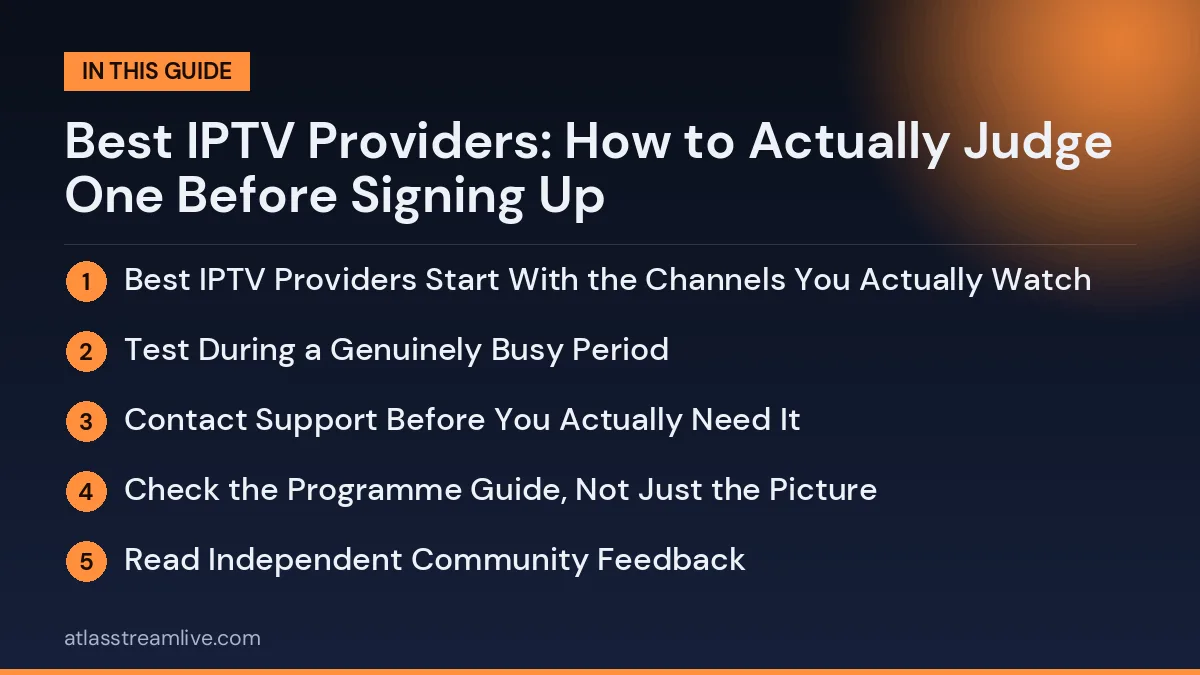
Best IPTV Providers Start With the Channels You Actually Watch
Ranked lists tend to focus on total channel numbers because it is an easy figure to compare across providers. In practice, a household rarely watches more than a few dozen channels regularly, and the rest of the number is padding from duplicate feeds and regions nobody in the house understands. Before comparing anything else, it helps to write down the specific channels used weekly, then check each provider directly against that list rather than trusting a total figure printed on a homepage.
This single step tends to eliminate half the options on any given ranked list within minutes, since many providers with impressive overall numbers turn out to be missing two or three channels a household actually cares about.
Want to test it on your own TV first? Try AtlasStream Live free for 24 hours on your Firestick, Smart TV or phone. No payment needed.
A provider can look completely reliable during a quiet weekday afternoon and fall apart entirely on a Saturday evening when demand across the network spikes. If football is a regular part of viewing, the trial should include at least one live match during a busy kick off slot rather than a recorded programme watched at a quiet time. This is the single most revealing test available, since server capacity issues only show up under genuine load, not during a calm demonstration.
Providers that hold up during peak demand almost always mention server infrastructure somewhere in their own materials, even briefly, since it is something they have actually invested in and are willing to talk about. Providers that avoid the topic entirely and focus purely on channel count are usually hoping nobody asks.
Contact Support Before You Actually Need It
The best time to test customer support is during a trial, before there is any real problem at stake. Sending a straightforward question and timing how long it takes to receive a genuinely useful reply, rather than an automated response, gives a fair preview of what to expect months later during an actual outage. It is also worth asking a slightly technical question rather than a generic one, since this reveals whether the person responding actually understands the service or is simply reading from a prepared script without any real knowledge of how the platform works.
A provider that responds quickly and clearly during a free period is far more likely to keep that standard once real money is involved, while one that is slow to respond before a sale is unlikely to suddenly improve afterwards.
An accurate and well maintained programme guide matters more than most comparisons admit. If the guide lists the wrong times or fails to update properly, planning an evening around a specific programme becomes far more difficult, and it usually signals that the underlying data feed is not receiving proper attention from the provider. Comparing the listed times against the actual broadcast schedule for a handful of programmes during a trial reveals how much genuine care goes into the parts of the service that rarely show up in a screenshot.
This detail gets skipped by almost every ranked comparison list, yet it has a real effect on how enjoyable a service is to actually live with day to day.
Read Independent Community Feedback
Community forums and social media groups built around streaming tend to reveal far more honest patterns than any officially published ranking. These spaces show which providers consistently perform well during major sporting events and which ones repeatedly struggle, based on real feedback from people with nothing to gain from the recommendation. It is particularly useful to search specifically for how a provider handled a recent significant event, since this tends to expose reliability issues that a polished homepage would never mention.
Patterns that repeat across many different community threads over time are far more trustworthy than a single glowing review that reads suspiciously close to marketing copy.
Compare Renewal Terms Across the Best IPTV Providers
Many comparisons focus entirely on the price shown during sign up and ignore what happens once the trial or introductory period ends. Some providers quietly increase pricing at renewal or make the cancellation process noticeably more complicated than the sign up flow ever was. Reading through the renewal terms before committing, rather than discovering them later, avoids one of the more common sources of frustration reported across community discussions.
A provider that keeps its renewal pricing transparent and consistent from the outset is generally a stronger long term choice than one relying on an attractive introductory rate to drive signups in the first place.
A Simple Scoring Sheet for Comparing Providers
When you compare the best IPTV providers, it helps to score each one in the same way. Give each provider a mark out of five for stream stability at peak time, picture quality, guide accuracy, support response time, clarity of pricing and ease of setup. Test them on the same device and connection, ideally during a busy evening or live match. Add up the scores at the end of the trial period.
A provider that scores well across all six areas is usually a better choice than one that excels in one area but fails in others. Writing the scores down stops you from being swayed by marketing claims or one good evening, and gives you a clear, fair comparison based on your own home.
Judge Device Support Against What You Actually Own
A provider can perform beautifully on one platform and noticeably worse on another, and households rarely stream from a single device type anymore. Before settling on any of the options that show up on a best iptv providers list, it is worth checking whether the specific mix of devices in the home, whether a Firestick, an Android box, a smart television app, or a laptop, is genuinely well supported rather than just technically compatible.
Testing every device actually used in the household during a trial period, rather than assuming a good result on one screen applies everywhere, is the only reliable way to confirm this before committing to a longer subscription.
Look at How Long the Provider Has Actually Operated
A newly launched service can absolutely turn out to be excellent, but it comes with far less of a track record to judge against compared with one that has been running for several years and weathered multiple major events without falling apart. Providers that have operated for a longer period tend to have accumulated more community feedback, more visible history around how they handled past outages, and generally a clearer reputation one way or another. This does not mean newer services should be dismissed automatically, but it does mean a shorter history calls for slightly more caution and a longer trial period before committing to anything beyond a single month.
Searching specifically for how long a provider has been operating, alongside how its reputation has shifted over that time, gives a more complete picture than judging purely from current marketing material, which rarely mentions anything before the last redesign of the homepage.
Check How Simultaneous Streams Are Handled
A household rarely watches everything on a single screen, yet the number of devices allowed to stream at once is one of the least clearly advertised details across most providers. Before committing to any option that appears on a best iptv providers list, it is worth actually testing this limit during a trial, particularly in a household with more than one or two people who tend to stream independently in different rooms at the same time. Discovering this limitation after paying for a subscription is a far more common complaint than most comparison lists ever mention.
It also helps to check whether the limit applies per account or per household connection, since the two behave quite differently once a family is actually using the service day to day rather than during a single test run.
Look Past the Homepage Screenshots
Every provider presents its interface in the best possible light on its own website, captured under ideal conditions on the newest available device. This is not necessarily dishonest, but it rarely reflects what a typical household will experience on an older Firestick or a budget smart television. The only way to know what an interface genuinely feels like day to day is to test it directly, on the actual devices and the actual broadband connection that will be used going forward, rather than relying on a polished screenshot.
This is exactly why a trial period carries so much more weight than any promotional image, since it shows the service exactly as it will behave once the initial excitement of signing up has worn off and it simply becomes part of the household’s normal evening routine.
Keep a Short Record Rather Than Relying on Memory
A trial period tends to feel positive overall in the first few days simply because everything is new and there has been no time for small frustrations to build up. Writing down a brief note after each viewing session, even something as short as how the picture held up during a specific programme or how long a channel took to load, produces a far more honest final impression than judging the whole experience purely from memory once the trial has ended.
Small issues that seemed forgettable on day one often turn out to be the exact same problems that eventually push someone to cancel a subscription months later, and spotting that pattern early is the entire point of testing properly rather than casually.
Reading back through these notes once the trial period is nearly finished tends to reveal a clearer overall picture than trying to recall a general impression days or weeks after the fact.
Building Your Own Ranking Instead of Trusting Someone Else's
The most reliable comparison is the one built from actual testing rather than borrowed from a list that never explained its own methodology. Running trials across two or three providers using the same checklist, covering channel accuracy, peak hour stability, support response, and device compatibility, produces a far more honest ranking than any article claiming to have already done the work. It takes a bit more effort than simply reading a list, but it is the only way to know with any real confidence which provider actually deserves a place among the best iptv providers for a specific household rather than for a generic audience the list was written for.
It also builds a genuine record to fall back on if the chosen provider changes noticeably down the line, since there will already be a clear sense of what good performance actually looked like when the subscription first started. Try AtlasStream Live free here and use it as the baseline test against whichever other services are being considered for the household.
A Simple Scorecard for Comparing the Best IPTV Providers
Memory is unreliable when you are comparing two or three services over a week. A short scorecard keeps the comparison honest. Give each provider a score out of five for every row, then add them up at the end.
What to score
What a 5 looks like
What a 1 looks like
Evening stability
No buffering on live channels between 7pm and 10pm
Regular freezing during big matches
Channel load time
Most channels open in two or three seconds
Long black screens when switching
Programme guide
Accurate listings for your region
Missing or wrong programmes
Support
A real person replies quickly and solves the issue
Slow, scripted or no reply
Pricing clarity
Same price at sign-up and renewal, all costs shown
Hidden renewal increases or extra fees
Devices
Works on every device you own
Only works well on one platform
A score of 25 or more out of 30 is a strong result. Anything under 18 suggests you should keep looking, however good the marketing appears.
What Fair Pricing Looks Like Among the Best IPTV Providers
Price matters, but only alongside everything else on the scorecard. When you compare the best iptv providers, look at the cost per month across different plan lengths rather than just the headline number. Longer plans are usually cheaper per month, but they only make sense once you are confident in the service after a trial.
Be cautious of two extremes. A price far below everyone else often means overloaded servers and poor support. A price far above the market does not guarantee better quality either. The sweet spot is a clearly listed price, the same at renewal, with no card needed to try the service first.
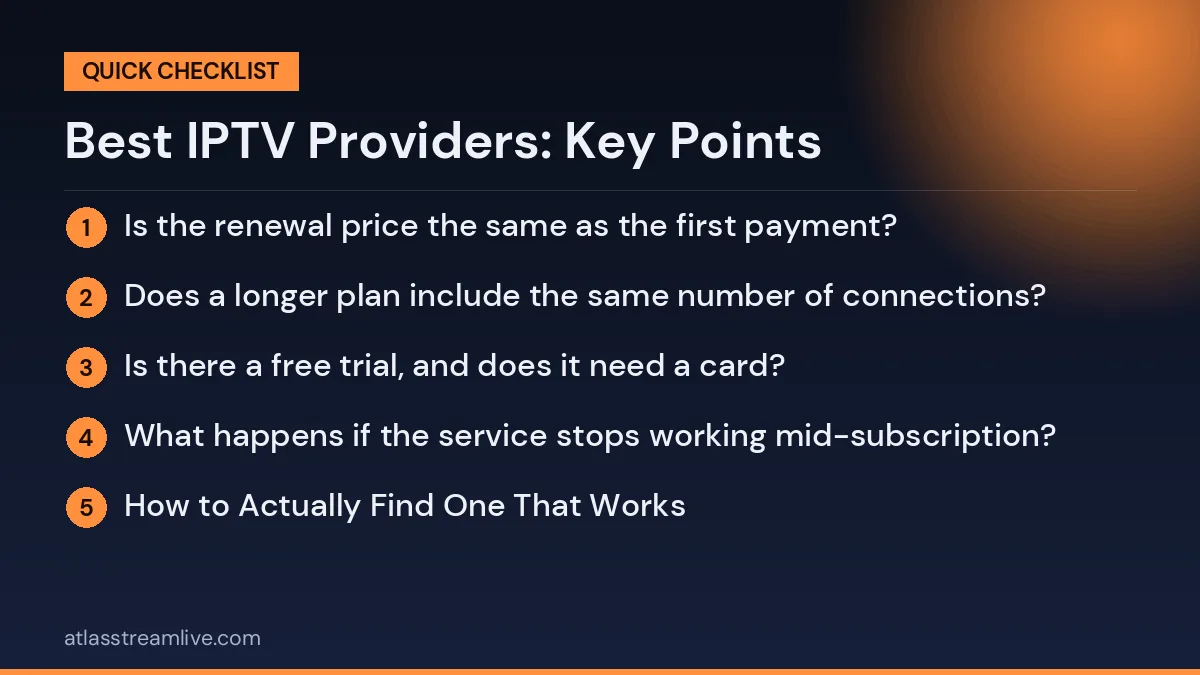
Questions to ask about pricing before you pay
Is the renewal price the same as the first payment?
Does a longer plan include the same number of connections?
Is there a free trial, and does it need a card?
What happens if the service stops working mid-subscription?
Where to Find Honest Feedback on the Best IPTV Providers
Independent review platforms such as Trustpilot can help, but read the recent reviews rather than the overall score, and look for detailed comments about specific problems and how they were handled. Generic five-star reviews posted on the same day are worth ignoring. For general guidance on paying for services online safely, Which? consumer rights is a useful starting point.
Best IPTV Providers: Quick Answers
Is the provider with the most channels always the best?
No. A huge channel count means little if the channels you watch are unstable. Judge the best iptv providers on the twenty or thirty channels you actually use.
How many providers should I compare?
Two or three is enough. Testing more than that tends to blur together, and you lose track of which service did what.
How long should I test before deciding?
At least one full evening, ideally including a live sports event, because that is when weaknesses show up.
Should I switch if my current provider is only average?
Only if the scorecard gives you a clear reason. Switching takes time, and a new service brings its own unknowns. If your current provider scores well on evening stability and support but loses a point or two on the programme guide, that is usually not worth a move. If it fails on stability during live sport, which is when most people notice problems, testing one of the other best iptv providers on a free trial is a sensible next step.
Whichever way you go, keep your scorecard. Running the same test again in six months shows quickly whether a service has improved, stayed the same or slipped.
Used this way, the scorecard turns a confusing market into a clear, personal ranking you can actually trust.
Take your time, test properly during a busy evening, and let the numbers on your scorecard make the decision for you rather than the loudest advert or the longest channel list.