Reading IPTV reviews UK customers leave online is a natural first step, but reviews only help if you know how to judge them.
If you have searched for an IPTV service in the UK, you will have seen a stream of provider names in search results, forum threads and comparison pages. Finding an assessment you can trust is harder. Much of what you read is either paid promotion, an affiliate link in disguise, or an old forum post with no detail. This guide does not rate any named provider. It shows you how to judge the reviews themselves and how to reach your own verdict.
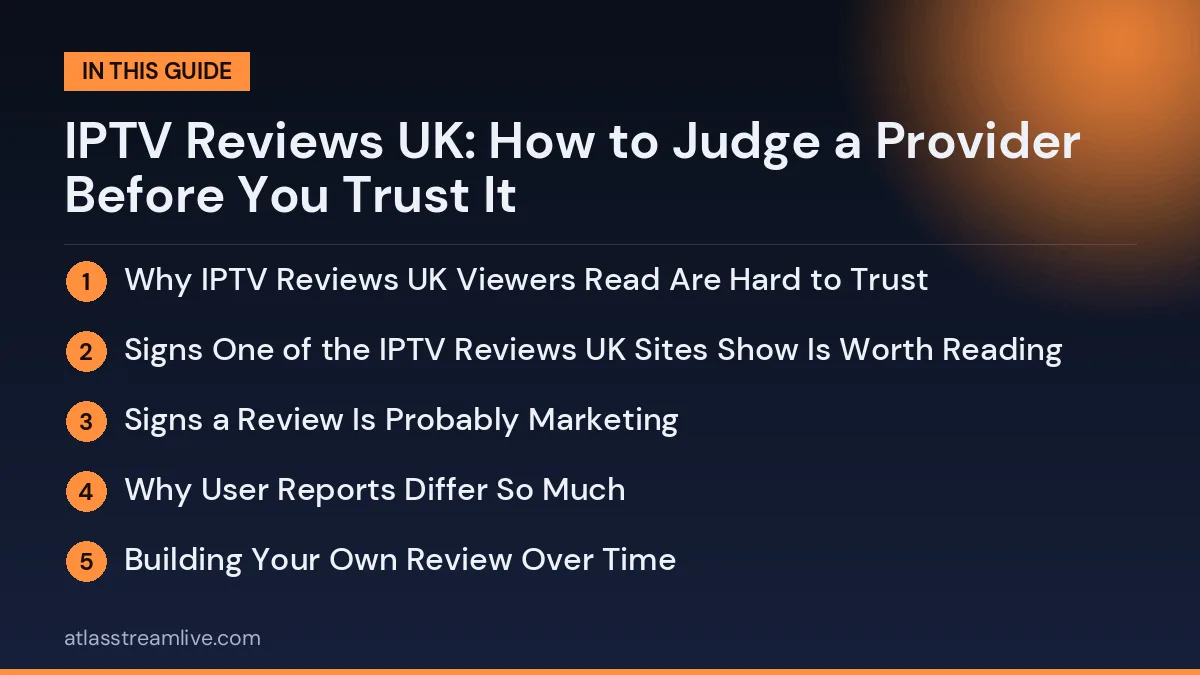
Why IPTV Reviews UK Viewers Read Are Hard to Trust
Review pages often earn money when you click through and buy, which gives them a reason to rate every service highly. Others are written by the provider or by someone connected to it. Forum posts and social comments can be genuine, but they are usually a single person’s experience on one device, at one time, on one internet connection.
Want to test it on your own TV first? Try AtlasStream Live free for 24 hours on your Firestick, Smart TV or phone. No payment needed.
That does not make every review useless. It means a review is a starting point for questions, not an answer.
Signs One of the IPTV Reviews UK Sites Show Is Worth Reading
A useful review says what was tested, on which device, at what time of day and for how long. It mentions a downside as well as an upside. It describes support interactions in specific terms, such as what was asked and how long the reply took. It is dated, because a service can change a lot in a few months.
Signs a Review Is Probably Marketing
Be careful with reviews that give every service the same top score, use vague phrases like “best quality ever” without examples, push one provider at the end with a prominent button, or make claims about numbers of channels and perfect uptime that nobody could measure from the outside. Be equally careful with reviews that attack one named service with detailed allegations but cite nothing you can check.
Why User Reports Differ So Much
Two people on the same service can have very different experiences. Their internet speed, router, device, app and viewing time all change what they see. A buffering complaint might come from a slow Wi-Fi link, an old Firestick or an overloaded app rather than from the provider. Our IPTV troubleshooting guide shows how to tell the difference.
Building Your Own Review Over Time
The most reliable IPTV reviews UK viewers can use are the ones they create themselves. After a few weeks with a service, you know much more than any short online review can tell you. Keep a simple log for the first month: note any buffering, missing channels, guide errors and support replies. At the end of the month, you will have a clear record of how the service performs in your home.
This log is useful in several ways. It helps you decide whether to renew, gives you facts if you need to raise a problem with support, and lets you compare fairly if you ever switch providers. It also protects you from being influenced by a single bad evening or one glowing review online.
What to record
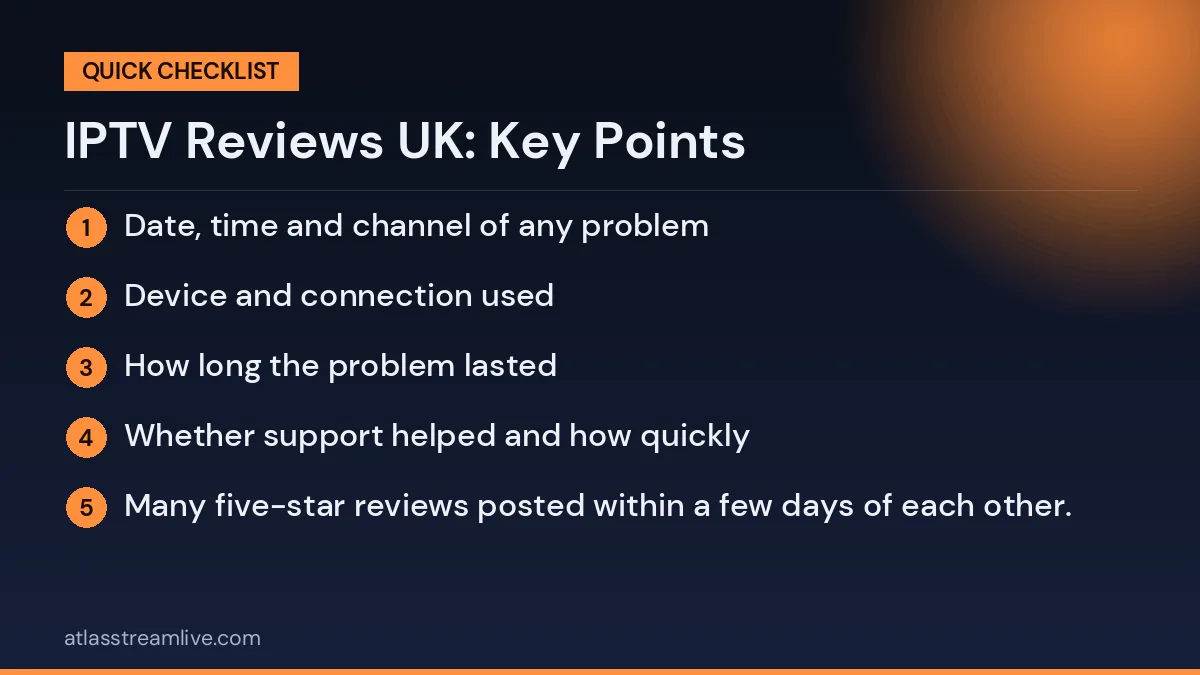
- Date, time and channel of any problem
- Device and connection used
- How long the problem lasted
- Whether support helped and how quickly
If you choose to write a review for others, base it on these notes. Specific, honest details help other UK viewers far more than general praise or complaints.
Spotting Fake or Unhelpful Reviews
Not every review online is genuine or useful. Be cautious of reviews that are very short, overly enthusiastic, posted on the same day in large numbers or written in a very similar style. Equally, a single angry review may reflect one bad evening rather than the service overall. Look for detailed reviews that mention devices, times of day and specific problems or strengths. These give a far more realistic picture of what to expect.
What to Do Instead of Trusting Reviews
The most reliable review is your own. Use a free trial to test the service on your own device, over your own connection, at the time you normally watch. Check the specific channels you care about. Send support a real question and note how long the reply takes. Our guide on what to check in a free IPTV trial lays out the steps, and how to judge an IPTV provider covers what to compare.
How to Read IPTV Reviews UK Viewers Post Online
IPTV reviews UK customers leave on forums, review sites and social media can be genuinely useful, but only if you read them carefully. A simple method helps you separate real experiences from noise.
- Sort by newest. Services change over time, so a review from two years ago may describe a very different service.
- Read the three-star reviews. They are often the most balanced, explaining both what works and what does not.
- Look for specifics. Device, time of day, type of content and what support did are all signs of a real experience.
- Look for patterns. One complaint is an anecdote. Many describing the same problem is evidence.
- Read the replies. How a provider responds to criticism tells you how it treats customers.
Fake Reviews and the Law
In the UK, fake reviews are now specifically banned under consumer protection law, and businesses can face serious penalties for posting or commissioning them. The Competition and Markets Authority enforces these rules. That does not mean fake reviews have disappeared, so it still pays to be sceptical.
Common signs of fake or incentivised reviews
- Many five-star reviews posted within a few days of each other.
- Very short, generic praise such as best service ever with no detail.
- Reviewers with no other history, or who only ever review one company.
- Language that sounds like an advert rather than a person.
- Reviews that mention a discount code or reward for leaving feedback.
Why Two Honest Reviews Can Disagree
One customer says a service is flawless; another says it buffers constantly. Both may be telling the truth. Experience depends heavily on things outside the provider control:
| Factor | How it affects the experience |
|---|---|
| Home broadband | Slow or congested connections cause buffering on any service |
| Wi-Fi signal | A TV far from the router can struggle even on fast broadband |
| Device | Old or overheating streaming sticks perform poorly |
| Time of day | Evenings and weekends are far busier than mornings |
| Content | Live sport is much more demanding than on demand |
When you read a review, ask which of these might explain it. A complaint from someone streaming 4K over weak Wi-Fi tells you little about how the service will work on your wired connection.
Where to Find Useful Feedback
Different sources offer different kinds of insight.
- Independent review platforms collect many reviews in one place. Look at recent ones and how the provider replies.
- Community forums often contain detailed technical discussions about specific devices and apps.
- Social media groups can be helpful but are easy to manipulate, so treat them with extra caution.
- Friends and family who use a service on a similar connection are often the most reliable source of all.
Be careful with comparison sites that rank providers without explaining how. Some earn money from the companies they list, which can influence the order.
Turning Reviews Into a Shortlist
Reviews work best as a filter, not a final decision. Use them to remove services with clear, repeated problems such as disappearing without notice, never answering support, or charging unexpected fees. Then take the two or three that remain and test them yourself with a free trial. Your own experience, on your own TV and connection, is the only review that really matters.
Writing Your Own Honest Review
If you decide to leave a review after using a service, make it useful for others. Mention your device, your type of broadband, the times you usually watch and the kinds of content you enjoy. Describe any problems clearly and say how support handled them. A detailed, balanced review helps other UK viewers far more than a single star or a one-word comment.
Checking the Business Behind the Reviews
Reviews tell you about experiences. They do not always tell you who you are dealing with. Before paying, check the basics: a named business, written terms and conditions, a refund policy, safe card payment and a clear way to contact support. If a provider claims to be a UK company, you can look it up on the official Companies House register. A service with great reviews but no identifiable business behind it still carries risk.
Testing a Provider Yourself: A Simple Plan
After reading IPTV reviews UK viewers have shared, the next step is to see for yourself. A planned 24-hour test answers the questions reviews cannot.
| When | What to test |
|---|---|
| Afternoon | Setup on your main TV, channel list, programme guide |
| 7pm to 10pm | Live channels for at least 30 minutes, channel switching, live sport if possible |
| Late evening | An on-demand film, skipping forward, subtitles |
| Next morning | A second device, and a message to support |
Compare what you find with what reviews said. If they match, the reviews were useful. If your experience is better or worse, trust your own results, because they reflect your real home setup.
Questions Reviews Rarely Answer
- Will the service work well on my specific TV and device?
- Will my broadband cope at the times I watch?
- Are the channels I care about included and stable?
- Is the programme guide accurate for my region?
- How quickly will support reply to me?
Only a trial can answer these, which is why reviews should guide your shortlist rather than make your final choice.
Red Flags That Override Good Reviews
Some warning signs matter more than any number of positive reviews:
- Payment only by crypto, gift card or transfer to a personal account.
- No company details, terms or refund policy.
- Pressure to buy a long plan immediately.
- No free trial and no way to test first.
- Support only through a social media account.
If you see these, step back regardless of what reviews say.
Balancing Reviews With Your Own Judgement
Reviews are one tool among several. They are best for spotting serious, repeated problems and for building a shortlist. Your own judgement, informed by a proper trial and basic checks on the business, should make the final decision. Combine the two and you will avoid most bad experiences while still finding a service that genuinely suits your home.
Reading Reviews About Specific Devices
Some of the most useful reviews focus on a particular device. A detailed post about how a service performs on an older Firestick, a Samsung Smart TV or an Android box tells you far more than a general opinion, especially if you own the same device. Search for reviews that mention your exact setup. If several people report the same issue on the same device, it is worth testing that carefully during your own trial, or asking support whether a different app works better.
Reviews Over Time: Spotting Decline or Improvement
Services change. A provider with excellent reviews last year may have grown too quickly and struggled to keep up, while one with poor early reviews may have invested and improved. Look at how reviews change month by month. A sudden wave of complaints about buffering or missing support replies can be an early warning sign. A steady improvement in recent feedback can be a good reason to give a provider a fair trial.
How Support Responses Reveal the Truth
Pay close attention to how a provider replies to negative reviews. A reply that apologises, explains what went wrong and offers a clear fix suggests a business that cares. Defensive replies, blaming the customer or no reply at all suggest the opposite. In many ways, the replies are more revealing than the reviews themselves, because they show how the provider behaves when things go wrong, which is exactly when you need them most.
Keeping Perspective
People are far more likely to write a review after a bad experience than after a normal evening of smooth viewing. That means even good services usually have some negative reviews. The question is not whether complaints exist, but whether they are frequent, serious and unresolved. Keeping that in mind helps you read feedback fairly and make a balanced decision.
A Quick Review-Reading Checklist
- Read recent reviews first, from at least two independent sources.
- Favour detailed reviews that mention devices, times and support.
- Look for repeated patterns rather than single complaints.
- Watch for bursts of short, generic five-star reviews.
- Check how the provider replies to criticism.
- Confirm the business details, terms and refund policy yourself.
- Finish with your own free trial before paying anything.
Used this way, reviews become a genuinely helpful starting point, and your own testing provides the final, trustworthy answer for your home.
Check the Basics Before You Pay
Before paying any provider, look for clear pricing, a clear way to contact support, and plain information on what is included. Read our guide to IPTV safety and legality in the UK so you know the risks around unofficial services, and check payment methods before you hand over card details.
Testing AtlasStream Live Yourself
We would rather you judge AtlasStream Live from your own test than from our description. We offer a free 24-hour trial with no credit card needed. Request it on the free trial page or message us on WhatsApp, then run the same checks you would run on any other provider.
The Bottom Line
Treat IPTV reviews as leads, not verdicts. Look for specific, dated, balanced detail, be wary of anything that reads like an advert, and put your own trial ahead of anyone else’s opinion, including ours.
IPTV Reviews UK: Frequently Asked Questions
Are star ratings reliable?
A star rating on its own tells you little. The number of reviews, how recent they are and what people actually wrote matter much more than the average score.
Should I trust reviews on the provider website?
Treat them as marketing. Providers naturally show their best feedback. Independent platforms and forums give a more balanced picture.
Why do some reviewers complain about buffering when others do not?
Home broadband, Wi-Fi, device and time of day all affect streaming. Two people can have very different experiences with the same service.
What if a service has no reviews?
A new service may simply not have built up feedback yet. Be extra careful: check the business details, use a free trial and start with a short plan.
Can reviews tell me if a service is legal?
Not reliably. Check for a named business, clear terms and safe payment, and ask the provider directly about its content rights.
How many reviews should I read?
Ten to twenty recent, detailed reviews from different sources usually give a good sense of common strengths and weaknesses.
Want to test it yourself? Request your free 24-hour trial.
Already sure? See plans and subscribe → · from £15, no contract.